5 Common Mistakes in Machine Learning Projects
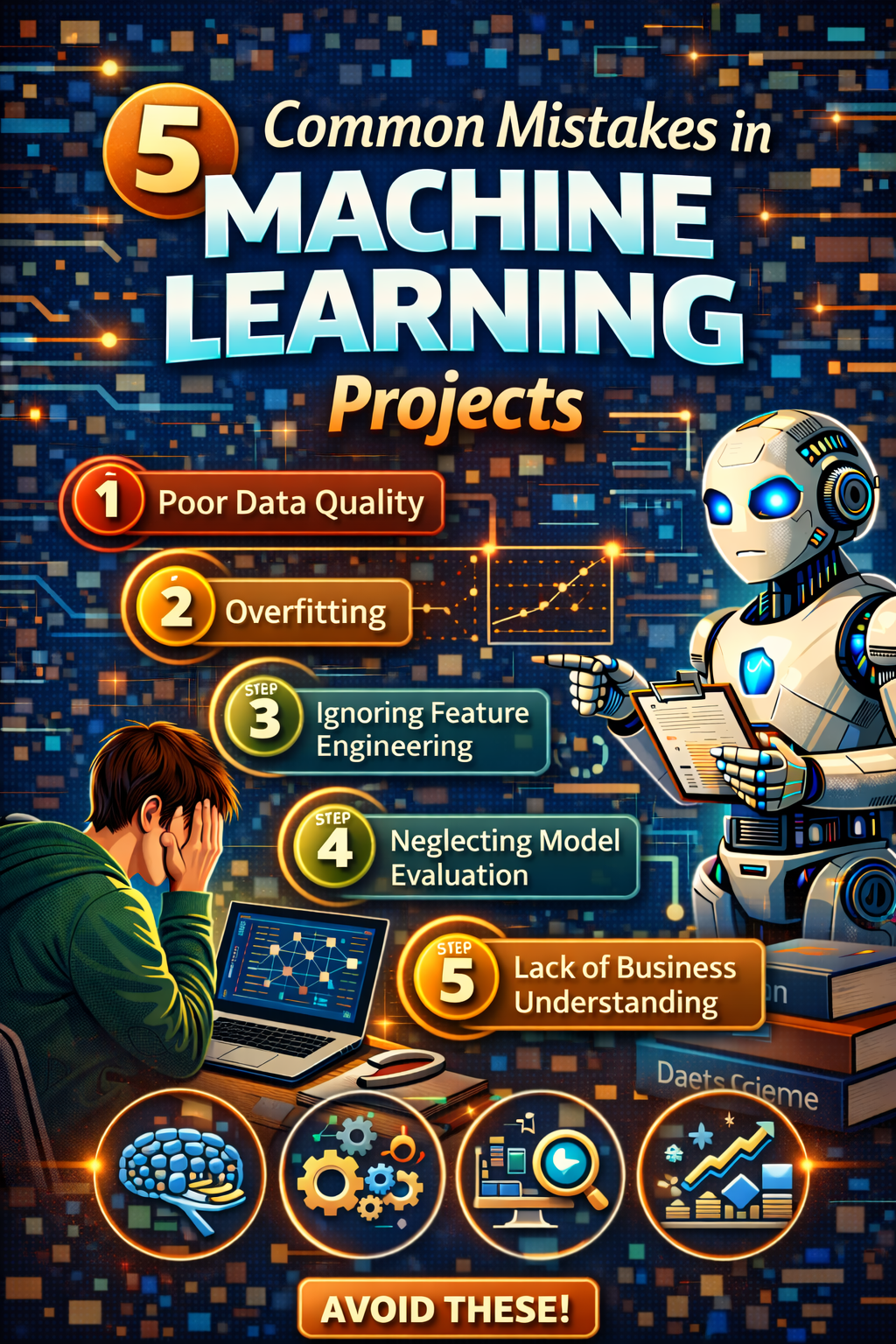
Machine learning projects are notorious for being easy to start but incredibly difficult to finish. It’s rarely the math that sinks a project; usually, it’s the logistics, the data, or the expectations.
Here are five common pitfalls that can turn a promising ML model into a costly mistake.
1. Using "Dirty" or Biased Data
The old adage "Garbage In, Garbage Out" is the golden rule of ML. If your training data is messy, unrepresentative, or contains hidden biases, your model will simply learn to replicate those errors at scale.
The Trap: Jumping straight to model architecture without spending weeks cleaning and auditing data.
The Fix: Invest heavily in Exploratory Data Analysis (EDA). Check for missing values, outliers, and class imbalances before writing a single line of training code.
2. Overcomplicating the Model (Overengineering)
It is tempting to use a massive Transformer or a Deep Neural Network for every task, but often, a simple Logistic Regression or a Random Forest will do the job better, faster, and cheaper.
The Trap: Chasing the "state-of-the-art" (SOTA) when a simpler model offers better interpretability and lower latency.
The Fix: Always establish a baseline. Start with the simplest possible model. If a complex model doesn't significantly outperform the baseline, it's not worth the technical debt.
3. Data Leakage
Data leakage occurs when information from outside the training dataset is used to create the model. This leads to "god-like" performance during testing that completely collapses in the real world.
The Trap: Including the target variable (or a proxy for it) in your features, or performing feature scaling/normalization on the entire dataset before splitting it into train and test sets.
The Fix: Strictly separate your training and testing pipelines. Ensure that your model only "sees" information it would realistically have access to at the moment of prediction.
4. Ignoring the "MLOps" Side (Deployment & Monitoring)
A model in a Jupyter Notebook is a research project; a model in production is a product. Many teams forget that models degrade over time as the real world changes—a phenomenon known as Data Drift.
The Trap: Treating ML deployment like traditional software deployment.
The Fix: Build monitoring systems to track performance post-launch. Set up alerts for when the input data distribution shifts significantly from what the model was trained on.
5. Solving the Wrong Problem
Many ML projects fail because they aren't aligned with business goals. You might build a model with 99% accuracy, but if it takes 10 seconds to generate a prediction for a real-time application, it's useless.
The Trap: Optimizing for technical metrics (like RMSE or F1-score) without considering business constraints (like latency, cost, or explainability).
The Fix: Define success criteria with stakeholders before starting. Ask: "What happens if the model is wrong?" and "How fast does this need to be?"
Comparison of Approach: Success vs. Failure
| Feature | The "Mistake" Approach | The "Best Practice" Approach |
| Focus | Model Architecture | Data Quality |
| Starting Point | Complex Neural Networks | Simple Baselines |
| Validation | Testing on Training Data | Strict Train/Test/Val Split |
| Goal | Highest Accuracy | Business Value & Reliability |